
EXTERNAL STRUCTURE OF THE EARTH
External structure of the earth consists of four main layers’. These are Atmosphere, Hydrosphere, Lithosphere and Biosphere.
1. THE ATMOSPHERE
Is the thin layer of gases held on the earth by gravitation’ attraction. It composed by abiotic (nonliving matter) and biotic living organism. Non-living matter found in the atmosphere includes mixture of gases, water vapor and dust particles. The living organism include the smallest or microscopic organisms like bacteria
STRUCTURE OF ATMOSPHERE
According to the temperature changes, atmosphere divided into two zones. These are Homosphere and Heterosphere
i) Troposphere
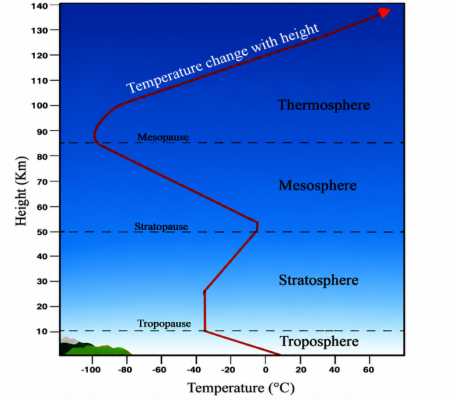
This layer extends by 0 – 15km above the sea level. Troposphere is the first layer of homosphere located nearest to the earth. It contains water vapor, gases and dust particles. It is the layer of atmosphere which support life on the earth due to the presence of plenty oxygen gas. All processes of rainfall formation take place in this layer and the temperature decreases as the altitude increases at the rate of per every 100 meters or per every 1000 meters.
Note: This situation where by temperature decreases as altitude increases is called lapse rate and because it occur near to the ground is called environmental Lapse rate.
The upper limit of Troposphere which separates it to the next later is called Tropopause. Tropopause makes the upper limit of troposphere to the next layer called stratosphere.
ii) Stratosphere
Stratosphere exists between 15 – 48 km above the sea level. This is the second layer of homosphere which lies above the tropopause. It is also composed of water vapor, dust particles and various gases. It is the layer of atmosphere which characterized by high concentration of Ozonic gases. This gases form Ozone layer which found particularly at 20 –35 km in the stratosphere.
The ozone layer is the layer which form a shield or cover that prevent the earth’s surface from destroying by the sun rays. It prevents the direct incoming of harmful rays from the sun to fall direct on the earth’s surface. The temperature remains unchanged about between 20 – 35 km from the earth’s surface. Then temperature increases with height to about at the upper limit of stratosphere called stratopause. The increase in temperature with height is referred to as temperature invasion.
iii) Mesosphere
This layer extends between 48-80 kilometers above the sea level. Mesosphere is the third part of the homosphere where temperature decreases as the altitude increases. It separated from the stratosphere by the zone of separation called stratopause. The upper limit of mesosphere is called mesopause. Mesopause record minimum temperature of this zone that may fall to making this zone to be coldest. It is at this zone where strong upper air streams of wind like jet streams are experienced.
Iv)Thermosphere
Is where temperature increases as the altitude increases from i.e. temperature invasion. This is because there is no water vapor or dust particle in this zone Ionosphere consists of some ions which influence radio waves. This is because, ionosphere is electrically charged with free electrons that allow the passage of radio waves, television waves and telephone or mobile phone waves.
V) Exosphere
Exosphere is the outermost layer of the Earth’s atmosphere, located above the thermosphere. It is the region where the atmosphere gradually thins out and merges into outer space, and gases such as hydrogen and helium can escape into space.
Function of Atmosphere
• Insulation Atmosphere is an insulator, it acts as a shield or blanket and therefore regulates temperature during the night and during the winter.
• Filtration. The atmosphere is the filter, it filters solar insulation and percent ultra violet rays of certain length due to the presence of ozone layer in the stratosphere.
• Scientific function. Atmosphere is the scientific field, it is the field through which the scientific experiments and observation carried out. Example ionosphere layer of atmosphere reflects some electromagnetic waves and ration signals back to the earth.
• It supports much on hydrological cycle. The surface water, evaporation, condensation and precipitation formation take place in the atmosphere.
2. THE HYDROSPHERE
Is the layer of water bodies of the earth including all oceans, rivers, precipitation and underground water. It is estimated that 75% of the Earth’s surface is covered by water bodies.
External structure of the earth consists of four main layers’. These are Atmosphere, Hydrosphere, Lithosphere and Biosphere.
1. THE ATMOSPHERE
Is the thin layer of gases held on the earth by gravitation’ attraction. It composed by abiotic (nonliving matter) and biotic living organism. Non-living matter found in the atmosphere includes mixture of gases, water vapor and dust particles. The living organism include the smallest or microscopic organisms like bacteria
STRUCTURE OF ATMOSPHERE
According to the temperature changes, atmosphere divided into two zones. These are Homosphere and Heterosphere
i) Troposphere
This layer extends by 0 – 15km above the sea level. Troposphere is the first layer of homosphere located nearest to the earth. It contains water vapor, gases and dust particles. It is the layer of atmosphere which support life on the earth due to the presence of plenty oxygen gas. All processes of rainfall formation take place in this layer and the temperature decreases as the altitude increases at the rate of per every 100 meters or per every 1000 meters.
Note: This situation where by temperature decreases as altitude increases is called lapse rate and because it occur near to the ground is called environmental Lapse rate.
The upper limit of Troposphere which separates it to the next later is called Tropopause. Tropopause makes the upper limit of troposphere to the next layer called stratosphere.
ii) Stratosphere
Stratosphere exists between 15 – 48 km above the sea level. This is the second layer of homosphere which lies above the tropopause. It is also composed of water vapor, dust particles and various gases. It is the layer of atmosphere which characterized by high concentration of Ozonic gases. This gases form Ozone layer which found particularly at 20 –35 km in the stratosphere.
The ozone layer is the layer which form a shield or cover that prevent the earth’s surface from destroying by the sun rays. It prevents the direct incoming of harmful rays from the sun to fall direct on the earth’s surface. The temperature remains unchanged about between 20 – 35 km from the earth’s surface. Then temperature increases with height to about at the upper limit of stratosphere called stratopause. The increase in temperature with height is referred to as temperature invasion.
iii) Mesosphere
This layer extends between 48-80 kilometers above the sea level. Mesosphere is the third part of the homosphere where temperature decreases as the altitude increases. It separated from the stratosphere by the zone of separation called stratopause. The upper limit of mesosphere is called mesopause. Mesopause record minimum temperature of this zone that may fall to making this zone to be coldest. It is at this zone where strong upper air streams of wind like jet streams are experienced.
Iv)Thermosphere
Is where temperature increases as the altitude increases from i.e. temperature invasion. This is because there is no water vapor or dust particle in this zone Ionosphere consists of some ions which influence radio waves. This is because, ionosphere is electrically charged with free electrons that allow the passage of radio waves, television waves and telephone or mobile phone waves.
V) Exosphere
Exosphere is the outermost layer of the Earth’s atmosphere, located above the thermosphere. It is the region where the atmosphere gradually thins out and merges into outer space, and gases such as hydrogen and helium can escape into space.
Function of Atmosphere
• Insulation Atmosphere is an insulator, it acts as a shield or blanket and therefore regulates temperature during the night and during the winter.
• Filtration. The atmosphere is the filter, it filters solar insulation and percent ultra violet rays of certain length due to the presence of ozone layer in the stratosphere.
• Scientific function. Atmosphere is the scientific field, it is the field through which the scientific experiments and observation carried out. Example ionosphere layer of atmosphere reflects some electromagnetic waves and ration signals back to the earth.
• It supports much on hydrological cycle. The surface water, evaporation, condensation and precipitation formation take place in the atmosphere.
2. THE HYDROSPHERE
Is the layer of water bodies of the earth including all oceans, rivers, precipitation and underground water. It is estimated that 75% of the Earth’s surface is covered by water bodies.