
CHAPTER FOUR: PHOTOGRAPH READING AND INTERPRETATION
Definitions of Photograph
- Photograph is picture produced by using a camera or satellite or radar, and then made visible and permanent by chemical treatment, or stored digitally. OR
- Photograph is a picture taken by means of chemical lights prepared on a special paper. OR
- Photograph is an image of an object which is recorded by a camera and then printed on paper.
Photograph interpretation is a process of reading, measuring and interpreting photographs for obtaining reliable information about natural or human features and their environment.
In other words, photograph interpretation can be defined as analysis and examination of photographs so as to be able to identify natural or artificial features.
Types of Photographs
1. Ground (Horizontal) Photographs
2. Oblique Photographs
3. Vertical Photographs
1. GROUND LEVEL PHOTOGRAPHS
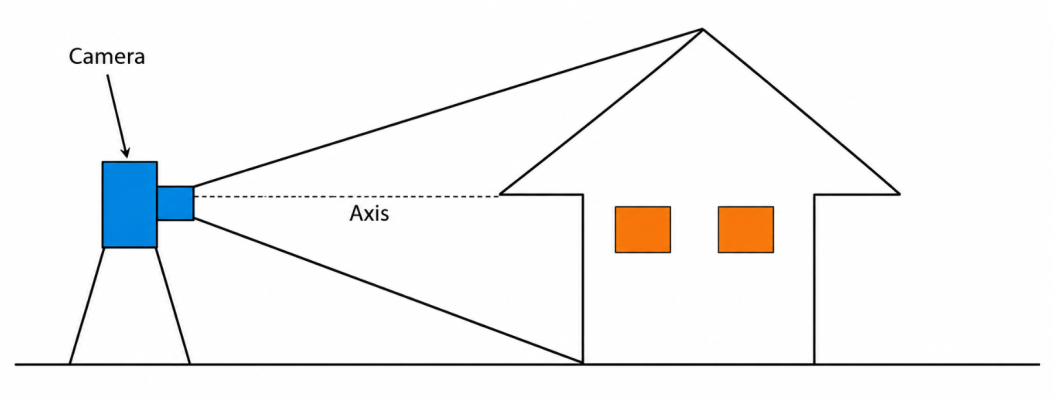
Are pictures taken horizontally whereby the camera and the object are at the same level. It is a picture taken when the camera axis is horizontal to the object. It is a camera taken at 1800
. These are the photographs taken on the level grounds when the optical camera axis is horizontal to the object.
TYPES OF GROUND/ HORIZONTAL PHOTOGRAPH
✓ Panorama horizontal photography: are general view photographs that show many items on an extensive landscape. They show one side of the features, with very wider horizon in the background. Panorama photograph can be obtained by takin multiple photographs and combining or stitching them together or taking one image using a camera with a wider format lens.
✓ Closed-up horizontal photograph: This is a particular view photograph focusing on ne specific object that needs to be interpreted.
Characteristics of Ground Level Photographs
i. The camera is at the same level as the object being photographed at 180o
ii. They show only the (front) side view of an object
iii. The camera is close to the Object.
iv. Its scale decrease from the foreground to the background
v. It covers a small area.
vi. It does not show the top view cleary.
vii. The fore ground and the horizon is seen but the back /dead ground is not seen
2. OBLIQUE PHOTOGRAPHS
These are the photographs taken from hills looking down with camera towards the ground. Sometimes they are taken from low flying planes, towers or from tall building at 450 to 800 Or, are the photographs taken when a camera is slanting at an angle less
than 90°. They are taken when the photographer is standing on an elevated ground and hold the camera on an angle towards the lower ground. They normally cover the horizon.
Definitions of Photograph
- Photograph is picture produced by using a camera or satellite or radar, and then made visible and permanent by chemical treatment, or stored digitally. OR
- Photograph is a picture taken by means of chemical lights prepared on a special paper. OR
- Photograph is an image of an object which is recorded by a camera and then printed on paper.
Photograph interpretation is a process of reading, measuring and interpreting photographs for obtaining reliable information about natural or human features and their environment.
In other words, photograph interpretation can be defined as analysis and examination of photographs so as to be able to identify natural or artificial features.
Types of Photographs
1. Ground (Horizontal) Photographs
2. Oblique Photographs
3. Vertical Photographs
1. GROUND LEVEL PHOTOGRAPHS
Are pictures taken horizontally whereby the camera and the object are at the same level. It is a picture taken when the camera axis is horizontal to the object. It is a camera taken at 1800
. These are the photographs taken on the level grounds when the optical camera axis is horizontal to the object.
TYPES OF GROUND/ HORIZONTAL PHOTOGRAPH
✓ Panorama horizontal photography: are general view photographs that show many items on an extensive landscape. They show one side of the features, with very wider horizon in the background. Panorama photograph can be obtained by takin multiple photographs and combining or stitching them together or taking one image using a camera with a wider format lens.
✓ Closed-up horizontal photograph: This is a particular view photograph focusing on ne specific object that needs to be interpreted.
Characteristics of Ground Level Photographs
i. The camera is at the same level as the object being photographed at 180o
ii. They show only the (front) side view of an object
iii. The camera is close to the Object.
iv. Its scale decrease from the foreground to the background
v. It covers a small area.
vi. It does not show the top view cleary.
vii. The fore ground and the horizon is seen but the back /dead ground is not seen
2. OBLIQUE PHOTOGRAPHS
These are the photographs taken from hills looking down with camera towards the ground. Sometimes they are taken from low flying planes, towers or from tall building at 450 to 800 Or, are the photographs taken when a camera is slanting at an angle less
than 90°. They are taken when the photographer is standing on an elevated ground and hold the camera on an angle towards the lower ground. They normally cover the horizon.