Ensures Accountability and Justice: Administrative systems establish courts and officials to check abuses of power. Example: Democratic systems ensure leaders are answerable to the people.
DISADVANTAGES OF ADMINISTRATIVE SYSTEMS
Possibility of Corruption and Abuse of Power: Leaders or officials may misuse their authority for personal gain. Example: Colonial administrators exploited resources and people.
Bureaucratic Delays: Too many procedures and paperwork can slow decision-making and service delivery. Example: In many modern states, getting licenses or permits takes a long time.
Suppression of Freedom: Some systems (autocratic, monarchical) limit freedom of speech, association, and participation. Example: Dictatorships like Idi Amin’s Uganda restricted political rights.
Inequality and Favoritism: Aristocratic or class-based systems benefit elites while ignoring common people. Example: Feudal Europe favored nobles over peasants.
High Cost of Maintenance: Running large administrative systems (armies, civil service, courts) requires heavy taxation. Example: Ancient kingdoms like Egypt demanded heavy tribute from peasants.
Resistance and Rebellions: Unjust or oppressive administrations can trigger revolts, instability, or wars. Example: Colonial administrations in Africa faced frequent resistance movements.
Rigidity and Lack of Innovation: Some systems (especially bureaucratic ones) resist change, sticking to tradition even when new solutions are needed. Example: Old Chinese bureaucracy was very slow to adapt to modern reforms.
REASONS FOR STUDYING ADMINISTRATIVE SYSTEMS IN THE ANCIENT WORLD (OBJECTIVES)
To Understanding the origins of governance: It helps us trace how early societies organized leadership, laws, and justice, laying the foundation for modern administration Example: Ancient Egypt had a centralized system under Pharaohs who combined political and religious authority, showing early forms of absolute rule.
Learning from successes and failures: Example: The Roman Empire developed an extensive bureaucracy and legal system, but corruption and overexpansion contributed to its fall, teaching lessons on administrative efficiency and limits. Hence we gain lessons for improving today’s systems
To Appreciating cultural diversity in leadership: Different regions (Africa, Asia, Europe, Middle East, South America) developed unique systems, showing how culture shaped governance, Example: In pre-colonial Africa, the Ashanti kingdom used councils of elders to advise the king, while in China, Confucian principles guided a merit-based civil service, illustrating different governance models shaped by culture.
Explaining continuity and change: It shows how ancient administrative practices influenced modern systems like democracy, monarchy, bureaucracy, or federalism. Example: Greek city-states practiced early forms of democracy, influencing modern democratic systems, while the Roman Republic introduced structured senates and legal codes still reflected in some legal systems today.
Promoting civic responsibility: Knowledge of past governance encourages citizens to value justice, accountability, and participation in public affairs today. Example: Ancient Israel’s governance was based on laws from the Torah, emphasizing justice and ethical responsibilities, which informed later moral and legal frameworks.
Supporting academic and intellectual development: Studying these systems sharpens analytical, historical, and comparative thinking skills, useful in politics, history, and public administration. Example: Studying the administrative efficiency of the Maurya Empire in India (with centralized bureaucracy and record-keeping) helps develop analytical skills in evaluating complex systems
ADMINISTRATIVE SYSTEMS IN ANCIENT ASIA
Introduction:
An administrative system in ancient Asia refers to the organized framework of governance used by various civilizations to maintain law and order, manage resources, collect taxes, and oversee the welfare of the population. These systems were influenced by culture, religion, philosophy, and geography.
Background:Ancient Asia had diverse administrative systems reflecting the needs of each civilization,
China: Strong centralized bureaucracies influenced by Confucian philosophy.
India: Kingdoms and empires used councils and local officials guided by Dharma (moral law).
Japan: Emperor-centered governance influenced by Shinto beliefs and later Confucian ideas.
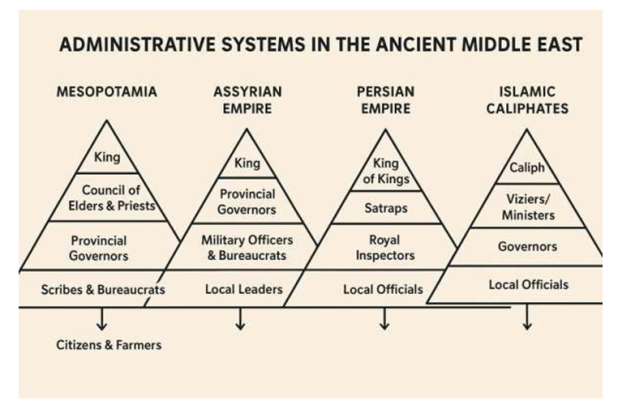
Persia (Achaemenid Empire): Highly structured bureaucracy with regional governors (satraps).
ANCIENT CHINA
Background:
China’s administrative systems were highly centralized, particularly during the Qin (221–206 BCE) and Han (206 BCE–220 CE) dynasties. Governance was based on
Confucian ideals emphasizing hierarchy, duty, and morality.
The Hierarchical Structure:
Emperor: Supreme authority over all political, military, and religious matters.
Grand Council/Chancellor: Assisted the emperor in making state policies and managing day-to-day governance.
Ministers: Headed departments like finance, justice, military, and public works.
Local Officials (Governors & Magistrates): Administered provinces and counties; responsible for law enforcement, tax collection, and census.
Village Heads: Supervised local communities and reported to higher authorities.
Administrative Practices:
I. Civil Service Exams: Recruitment of officials based on merit and knowledge of Confucian classics.
Codified Laws: Standardized legal codes (e.g., Qin legalist laws).
Taxation: Land tax and labor tax to support the state.
Census and Record-Keeping: Population registration to organize conscription, taxation, and corvée labor.
Military Administration: Commanded by appointed generals under imperial supervision.
Key Feature: Strong central authority with a merit-based bureaucracy ensured efficiency and stability.
ANCIENT INDIA
Background
Administrative systems varied by dynasty (Maurya, Gupta) but emphasized dharma (righteous duty) and hierarchical governance. Kautilya’s *Arthashastra* (Maurya period) was a seminal text outlining statecraft, administration, and law.
Hierarchical Structure:
Emperor (Chakravartin): Supreme ruler; combined political, judicial, and military powers.
Council of Ministers: Headed by a chief minister (Mahamatya), advisors for finance, defense, and internal affairs.
Provincial Governors (Rajukas): Managed provinces, enforced laws, and collected taxes.
Village Heads (Gramika) & Local Councils (Panchayat): Administered local affairs, disputes, and labor.
Citizens & Peasants: Paid taxes, performed labor for state projects.
Administrative Practices:
Revenue System: Land tax (Bali), trade duties, and tributes.
Judicial System: Judges appointed to maintain law and order; punishment guided by dharma.
Military Organization: Standing armies controlled by the emperor with local militia support.
Infrastructure & Public Works: Roads, irrigation, and urban planning administered through local officials.
Key Feature: Highly organized bureaucracy balancing central control with strong local governance.

 orts, railways, electricity, and industrial parks..
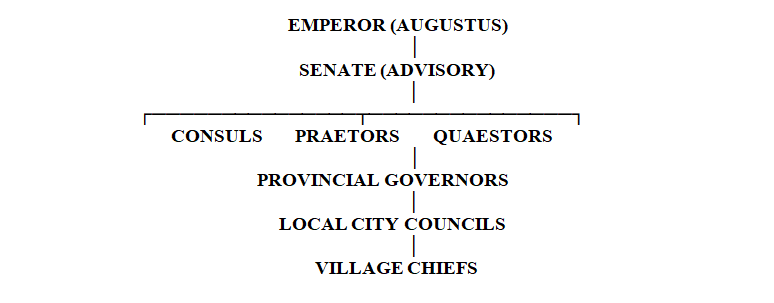
 By combining Athens (democracy), Rome (law & bureaucracy), and Sparta (discipline & military order), modern administrative systems became more balanced, structured, and citizen- oriented.
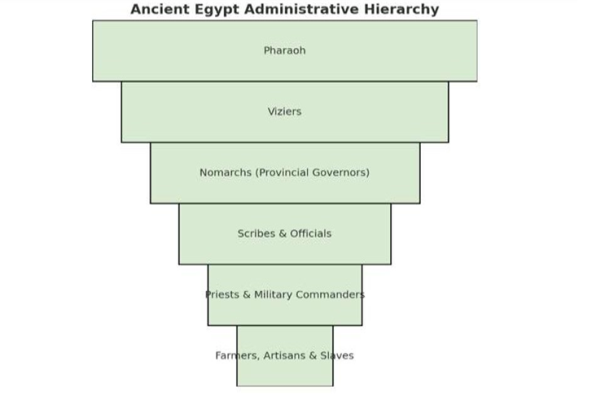
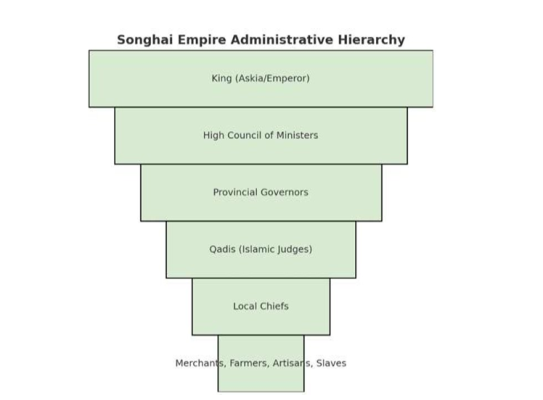
 Summary Comparison