NOTES TOPIC SIX: SLAVERY AND FEUDALISM IN ANCIENT ADMINISTRATIVE SYSTEMS

wazaelimu

Administrator
Staff member
Jun 15, 2026
896
0
16
SLAVERY AND FEUDALISM IN ANCIENT ADMINISTRATIVE SYSTEMS

Before the advent of slavery and feudalis, most of communities in the world lived in an egalitarian system and to a large extent these communities were classless. Classless communities were characterized through the following:

FEATURES OF COMMUNAL MODE OF PRODUCTION.​

Collective ownership: There was collective ownership of major means of production. E.g. Land was owned by the whole society. It led to absence of exploitation because means of production were not owned by few people.

Low level of production forces: It was characterized by low production due to the use of crude tools like bones, stone pebbles.

Absence of trading activities: Due to the absence of surplus production has led to the absence of traing system. Therefore under communalism production was based for consumption only.

Low level of production: This was due to low level of tools of production, that means non surplus and whatever produced was consumed.

Absence of exploitation of man bay man:There was no any exploitation of man by man because of existence of collective ownership of major means of production.

Absence of surplus production: due to application of poor productive forces like the use of stone tools.

Man's life depended on nature: Due to less experience of a man to control the environment. 8. Absence of surplus: Due to the use of crude tools in productio such as stone and bone instruments in production


SLAVERY SYSTEM AND ADMINISTRATIVE SYSTEMS

What is slavery Mode of production?

Slavery is a social, economic, and political system in which individuals are treated as the property of others, deprived of personal freedom, and forced to provide labor or services under coercion without fair compensation. It involves total control over the enslaved person’s life, often stripping them of identity, rights, and autonomy. Historically, slavery appeared in many societies, such as in ancient Egypt, where slaves worked on farms and construction projects like pyramids; in ancient Rome, where they served as gladiators, domestic servants, and administrators; in China, where convicts and war captives labored for the state; and in Africa, where captives of war or debtors were enslaved within communities or sold through the trans-Saharan and later trans-Atlantic slave trade. It was also central to the American plantation system, where Africans and their descendants were forced to produce cash crops like sugar, cotton, and tobacco under brutal conditions. Beyond physical labor, slavery also included concubinage, household service, and military roles, showing its wide-ranging exploitation of human beings across civilizations.


The slave mode of production was an economic and social system where slavery formed the basis of wealth and production.


ITS MAIN CHARACTERISTICS ARE:

Ownership of People as Property – Slaves were legally regarded as the property of their masters, who could buy, sell, or inherit them. For example, in ancient Rome, slaves were traded in markets just like goods.

Forced and Unpaid Labor – Slaves were compelled to work without wages, often under harsh conditions. For instance, African slaves in the American plantations produced cotton and sugar without payment.

Concentration of Wealth in Slave Owners’ Hands – The system benefited a small elite who controlled large numbers of slaves, creating economic inequality. In ancient Egypt, wealthy nobles used slave labor for farming and construction, enriching themselves.

Lack of Rights and Social Exclusion for Slaves – Slaves had no legal rights, could not marry freely, own property, or participate in governance. In Greece, slaves were excluded from citizenship and political life.

Use of Violence and Coercion – The system was maintained through force, intimidation, and punishment to prevent rebellion. For example, in the Caribbean plantations, slave rebellions were brutally suppressed to maintain order.

Dependence of Economy on Slave Labor – The prosperity of the state or empire largely depended on slave labor. For instance, the Roman Empire’s economy in agriculture, mining, and public works relied heavily on slaves..

 

WAYS SLAVES WERE OBTAINED (ACROSS ROME, CHINA, EGYPT AND OTHER PART OF THE WORLD)​


War Captives
– prisoners of conquered territories (Rome from Gaul, Egypt from Nubia, China from nomadic tribes).

Debt Slavery – people sold themselves or family members when unable to repay debts.

Criminal Punishment – criminals condemned to slavery instead of execution.

Raids & Kidnapping – pirates, bandits, and armies captured people for sale.

Trade & Markets – slave trade networks existed (Rome via Mediterranean, Egypt via Nubia, China via Silk Road regions).

Birth into Slavery – children of slaves automatically became slaves.

Self-Sale During Famine – in times of hunger, families sold themselves or children to survive.


GENERAL FACTORS FOR THE RISE OF SLAVERY ADMINISTRATIVE SYSTEMS

Military Conquests and Expansion​


Wars produced thousands of captives who were enslaved.

Example Rome: Captured Gauls, Greeks, and Carthaginians became slaves after wars.

Example Egypt: Conquered Nubians and Asiatics were enslaved after military campaigns.

Example China: Nomadic tribes (Xiongnu, Rong, Di) often supplied slaves after defeat


Agricultural Demand​

Large estates needed a stable labor force to support growing populations.

Example Rome: Latifundia (large estates) used slaves for wheat, olive, and wine production.

Example Egypt: Slaves worked on irrigation and farming along the Nile for temple and royal estates.

Example China: Noble estates used slaves in rice and millet cultivation.


Monumental Construction Projects​

States needed a massive, cheap labor force for infrastructure and monuments.

Example Rome: Slaves built aqueducts, amphitheaters (Colosseum), and roads.

Example Egypt: Slaves and forced laborers worked on temples, tombs, and irrigation canals (though pyramid workers were mostly paid corvée labor).

Example China: Slaves built palaces, canals, and the Great Wall.


Social Stratification & Hierarchy​

Slavery reinforced elite dominance and was justified by ideology.

Example Rome: Roman law (Dominium) gave masters full rights over slaves.

Example Egypt: Pharaoh’s divine authority made enslaving foreigners acceptable.

Example China: Confucian hierarchy placed slaves at the lowest level (jianmin).


Economic Expansion & Trade​

Slaves became commodities exchanged across regions.

Example Rome: Mediterranean slave trade brought captives from Africa, Asia, and Europe.

Example Egypt: Nubia supplied slaves through long-distance trade and tribute.

Example China: Slaves from Central Asia entered through Silk Road connections.

Weak Legal Protections for the Poor​

Laws favored elites and allowed enslavement of vulnerable groups.

Example Rome: Debtors could sell themselves (nexum), criminals could be condemned to slavery.

Example Egypt: Peasants unable to pay taxes or debts could fall into servitude.

Example China: Criminals and famine-stricken families often sold themselves or children into slavery.


Administrative Centralization of States​


Strong states could organize, register, and deploy slaves systematically.

Example Rome: State-owned slaves worked in mines, administration, and public projects.

Example Egypt: Pharaohs and temples controlled slave labor through estate administrators (imy-r pr).

Example China: The emperor’s bureaucracy assigned state slaves to imperial construction and service.

SLAVERY IN ANCIENT CIVILIZATIONS​

Slavery in Ancient Rome​

Background​

Slavery was central to Roman society and economy from the Republic (509 BCE) through the Empire (27 BCE – 476 CE). At its height, one-third of Rome’s population were slaves. Slavery was not based on race but rather conquest, debt, or birth. Roman law (e.g., Institutes of Justinian) codified slavery as the absolute power of the master (dominus) over the slave (servus).

Administrative Structure​

Slaves were treated as property (res mancipi) under Roman law.

Owners could buy, sell, punish, or free slaves.

State-owned slaves served the government (tax collection, public works, temples).

Household slaves were managed by the vilicus (overseer of estates).

Freed slaves (liberti) could become Roman citizens, though with limited rights.

A DIAGRAM SHOWING THE CLASS STRUCTURE OF THE ROMAN SLAVE STATE:​
 
Screenshot 2026-08-31 104443.png
✅ Explanation:

Top: Emperor — ultimate authority.

Upper Classes: Patricians and Equites — political, economic, and social power.

Middle Class: Plebeians — free but less powerful citizens.

Lower Classes: Freedmen — limited rights, still tied to former masters.

Bottom: Slaves — backbone of the economy but completely without rights.


Roles of Roman Slaves​


Domestic Servants
– cooking, cleaning, raising children, and attending masters.

Agricultural Laborers – worked on latifundia (large estates), vineyards, olive groves, and wheat fields.

Skilled Artisans – blacksmiths, builders, potters, teachers, and doctors (many Greek slaves served here).

Gladiators & Entertainment – fought in arenas or served as actors, musicians, and dancers.

Public Administration – secretaries, accountants, and clerks for magistrates and emperors.

Mining & Construction – forced into harsh labor in mines, quarries, and road building.


Class Structure of the Roman Slave State (Roman Republic & Empire)​


The Roman state, especially during the Republic and early Empire, was heavily based on a slave economy, and its society had a clear hierarchical structure:


Emperor / Patricians / Elite Landowners

At the top were the Emperor (in the Imperial era) or leading Patrician families (in the Republic).

They controlled vast estates, political power, and the economy.

Owned large numbers of slaves who worked on agriculture, households, mines, and workshops.

Equestrians (Equites) / Wealthy Merchants and Officials

Wealthy non-senatorial class.

Involved in trade, banking, tax collection, and administration.

Some owned slaves, though typically fewer than Patricians.

Plebeians / Free Citizens

Common free Roman citizens.

Worked as artisans, farmers (smaller scale than elite estates), soldiers, and laborers.

Limited political rights initially, but gained more over time.

Freedmen (Liberti)

Former slaves who had been freed.

Often worked in trade, crafts, or as household managers.

Their social mobility was limited; they were not fully equal to freeborn citizens.

Slaves (Servi)

At the bottom of the social hierarchy.

Slaves had no legal rights and were considered property.

Roles included: domestic service, farm labor, skilled crafts, teachers, clerks, gladiators, and miners.

Sources of slaves included war captives, piracy, trade, birth from enslaved mothers, and debt slavery.


Key Features of Roman Slave-Based Governance:


Economic and political power concentrated in the hands of the elite.

Slaves formed the backbone of production but had no political voice.

Governance was hierarchical, authoritarian, and reinforced by law and social norms.
 
Summary:
The Roman slave state was a rigid, hierarchical system where political and economic power was concentrated in the hands of a few, while the majority (slaves) had no rights. Contemporary governance, especially in democratic states, emphasizes citizen rights, rule of law, and social mobility, though inequalities still exist. Modern systems are far more inclusive and institutionalized compared to the elite-dominated Roman structure.​

1. Slavery in Ancient China​

Background​

· Present since the Shang Dynasty (1600–1046 BCE).
· Slaves were often war captives, criminals, or those who sold themselves during famine.
· Unlike Rome, slavery was less central to the economy but important for elite households and state projects.
· Confucianism emphasized hierarchy, making slavery socially accepted.


Administrative Structure​

· Slaves were considered the lowest social class (jianmin).
· State slaves worked on imperial projects (Great Wall, palaces, canals).
· Household slaves belonged to noble families and were managed by head servants.
· Some slaves could be integrated into households and sometimes rise to trusted positions.

Roles of Chinese Slaves​


1. Domestic Servants – cooking, weaving, cleaning, caring for children.
2. Agricultural Workers – farming rice, millet, and tea in noble estates.
3. Military Assistants – porters, armor carriers, horse handlers for armies.
4. Artisans & Craftsmen – bronze casters, silk weavers, pottery makers.
5. State Laborers – building the Great Wall, palaces, irrigation systems.
6. Entertainment & Concubines – singers, dancers, musicians, or sexual slaves for elites.
clip_image001.gif


2. Slavery in Ancient Egypt​

Background​

· Existed from the Old Kingdom (c. 2686 BCE) to Ptolemaic era.
· Slaves came from war conquests (Nubians, Libyans, Asiatics).
· Not as massive as Rome, but slavery was integrated into temples, palaces, and agriculture.
· Egyptians also practiced corvée labor (forced state service), sometimes confused with slavery.

Administrative Structure​

· Pharaoh held ultimate ownership of land and people.
· Slaves were property of the Pharaoh, temples, nobles, or military leaders.
· Slaves were managed within estates by stewards (imy-r pr).
· Some slaves were temple servants dedicated to gods.
· They could earn some rights, marry locals, and in rare cases, be freed.

Roles of Egyptian Slaves​

1. Domestic Servants – cooking, grinding grain, brewing beer, cleaning houses.
2. Field Laborers – working on irrigation, plowing, and harvesting crops.
3. Construction Workers – temples, tombs, pyramids (though many pyramid workers were paid laborers, not slaves).
4. Military Support – porters, chariot drivers, weapon makers, camp servants.
5. Temple Servants – worked in rituals, maintained temple estates, assisted priests.
6. Concubines & Entertainment – dancers, musicians, and servants for the royal court.
 
  • o Countries need comprehensive laws criminalizing all forms of human trafficking.
  • o Example: The United States’ Trafficking Victims Protection Act (TVPA) of 2000 imposes strict penalties on traffickers and has led to thousands of prosecutions.
  • o Educating communities helps people recognize trafficking and avoid risky situations.
  • o Example: Campaigns like “Blue Heart Campaign” by the UN use media to alert the public and reduce demand for trafficked labor and sex work.
  • o Police and border officials must be trained to detect trafficking networks and handle victims properly.
  • o Example: In Thailand, specialized anti-trafficking police units have successfully rescued thousands of victims in fishing and labor industries.
  • o Providing psychological support, education, and skills helps victims reintegrate and reduces the risk of re-trafficking.
  • o Example: Poland’s La Strada Foundation offers rehabilitation, vocational training, and legal assistance to trafficking survivors.
  • o Trafficking often crosses borders; countries must share intelligence and coordinate operations.
  • o Example: INTERPOL’s Operation Liberterra rescued victims across multiple European countries and arrested international trafficking networks.
  • o Reducing poverty and providing livelihoods decreases vulnerability to traffickers.
  • o Example: Programs in Nepal and India provide microloans and vocational training to women in rural areas, reducing their risk of being trafficked.
  • o Hotlines, online reporting platforms, and community watch programs help detect trafficking early.
  • o Example: Poland’s 24/7 Anti-Trafficking Hotline allows anonymous reporting and has led to numerous rescues.
  • 1. Propose any strategies that would effectively combat the practice of modern human trafficking
  • 1. Land-Based Economy: Wealth and power depended on ownership and control of land (fiefs). Land was the currency of influence and security.
  • 2. Hierarchical Social Structure: Clear division into kings, nobles, knights, and peasants (serfs), each with defined roles and duties.
  • 3. Mutual Obligations: Lords provided protection and justice; vassals offered military service; peasants provided labor and produce.
  • 4. Decentralized Power: Political authority was local, not centralized; lords controlled law and defense in their territories.
  • 5. Military Service: Nobles and knights were bound to provide armed service to their lords or the king in exchange for land or protection.
 
1. Limited Mobility: Social positions were largely inherited; peasants had little chance to change their status, though some mobility existed for knights or merchants.
2. Existence of feudal rents example rent in kind, rent in labour and rent in money
3. Private ownership of the major means of production
clip_image001.gif


1. Factors for the Rise of Feudalism in Europe​


1. Fall of the Roman Empire: Collapse of centralized authority created a power vacuum.
2. Need for Protection: Constant invasions by Vikings, Magyars, and Muslims required localized defense systems.
3. Decline of Trade: Reduced long-distance trade made self-sufficient estates more important.
4. Land as Wealth: Land became the primary source of wealth and security.
5. Weak Central Kings: Kings could not enforce law over vast territories, empowering local lords.
6. Military Necessity: Lords needed armed vassals to defend their lands.
7. Customs and Traditions: Germanic tribal traditions emphasized personal loyalty and service, which shaped feudal bonds.

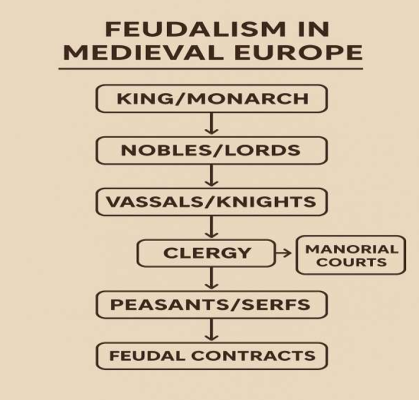
2. Structure of Administrative Systems in Medieval Feudal Europe​

Feudal administration was hierarchical and localized, with overlapping responsibilities:
1. King/Monarch: Held ultimate authority, granted lands to nobles, and relied on vassals for military support.
2. Nobles/Lords: Controlled large estates (manors), collected taxes/rents, administered justice, and maintained private armies.
3. Vassals/Knights: Served lords in military matters; managed smaller portions of land; ensured local security.
4. Clergy: Church officials also held land, influenced political decisions, and maintained law and moral order.
5. Peasants/Serfs: Worked the land, paid rent in crops or labor, and were bound to the manor, forming the base of the feudal economy.
6. Manorial Courts: Local courts run by lords to settle disputes among peasants and enforce feudal law.
7. Feudal Contracts: Written or oral agreements that formalized obligations between lords and vassals, ensuring loyalty and service
Screenshot 2026-08-31 115555.png
 
FEUDALISM IN JAPAN


Meaning and Background

Feudalism in Japan was a social, political, and economic system that dominated from the 12th to the 19th century. It emerged after the decline of imperial power and the rise of military rule under the shogunate, especially starting with the Kamakura period (1185–1333). In this system, loyalty, land ownership, and military service were closely linked. It resembled European feudalism but had its unique Japanese characteristics.


Emperor​


THE FEUDAL SOCIO-POLITICAL STRUCTURE IN JAPAN

Role: The emperor was the nominal ruler and a divine figure (considered a descendant of the sun goddess Amaterasu).

Power: Mostly symbolic; had little real political or military authority.

Function: Provided legitimacy to the shogun and the political system.


Shogun​

Role: The military dictator and de facto ruler of Japan.

Power: Controlled national politics, military, and foreign affairs.

Function: Oversaw the daimyo, enforced law, and maintained order.

Example: Tokugawa Ieyasu, founder of the Tokugawa Shogunate.


Daimyo​

Role: Powerful regional lords who owned large estates and ruled domains called han.

Power: Maintained private armies of samurai and collected taxes from peasants.

Function: Administered local governance, justice, and defense in their domains.

Obligation: Paid tribute to the shogun and provided military support when needed.


Samurai​

Role: Warrior class serving the daimyo.

Code: Followed Bushido, emphasizing loyalty, honor, and martial skill.

Function: Protected their lord’s land, enforced law, and participated in warfare.

Privileges: Could receive land or stipends in exchange for service.


Peasants (Farmers)​

Role: Backbone of the feudal economy.

Function: Worked the land, produced food, and paid taxes to the daimyo.

Status: Though essential, they were restricted socially and could not move freely.


Artisans and Craftsmen​

Role: Produced tools, weapons, clothing, and other goods.

Status: Below peasants in social hierarchy but crucial for supporting the economy.


Merchants​

Role: Traded goods and facilitated economic activity.

Status: Lowest in social hierarchy, often wealthy but socially looked down upon.


Hierarchical Structure (Top to Bottom)​

Emperor – Symbolic ruler

Shogun – Military ruler

Daimyo – Regional lords

Samurai – Warrior class

Peasants/Farmers – Producers of food

Artisans/Craftsmen – Makers of goods

Merchants – Traders

This structure created a rigid socio-political hierarchy where loyalty and military service determined political power, while occupation largely determined social status. It remained stable during the Tokugawa era (1603–1868), but limited social mobility and reinforced the authority of the shogunate and daimyo.


Example of Japanese Feudal System:

During the Tokugawa Shogunate (1603–1868), Japan was highly structured: the shogun ruled the country, daimyo controlled regional domains, samurai served the daimyo, and peasants farmed the land. The system maintained stability but restricted social mobility.


Impact:

Strengthened military rule and social hierarchy.

Limited central political power in favor of local lords.

Influenced Japanese culture, including ethics (bushido), arts, and governance

FEUDALISM IN AFRICA
 
FEUDALISM IN AFRICA


Feudalism in Africa
refers to a socio-political system where land was the main source of wealth and power. Local rulers or chiefs controlled large tracts of land, and commoners or peasants worked the land, paying tribute or providing labor in exchange for protection and use of land.

Background​


Feudal-like systems existed mostly in West Africa, East Africa, and parts of Central Africa.

In West Africa, kingdoms like Mali, Songhai, and Ghana had hierarchical structures with land allocated to nobles, who in turn controlled the peasantry.

In East Africa, pre-colonial kingdoms such as Buganda had chiefs managing land and collecting tribute from peasants.

African feudalism was often less rigid than European feudalism and incorporated kinship ties and community obligations

FORMS OF FEUDALISM IN SOME PARTS OF AFRICA

In African society’s feudal mode of production existed in different forms depending on the place in which it existed.

Nyarubanja system. In this form of feudalism the major means of production was land. Under Nyarubanja system in Buhaya and Karagwe there was two classes, that is the Batwazi (ruler) and Batwana (serfs). These two classes had to pay rent in kind and rent in labour services to the land lords. Nyarubanja were the small estates of land given to the serfs. The receiver of the land (peasant/serf) was known as batwarwa. The giver of the land was known as batwazi. Under nyarubanja system, the land was the major means of production and it was practiced in karagwe, Buhaya.

Mvujo and Busulo: In Buganda Nyarubanja system known as Mvunjo and Busulo, there were two classes that is Bataka (chiefs) and the poor people who rendered labour service and paid of their products to the land lords known as Bakopi. Under the system labour services provider was known as Akasamvu and part of their products was provided to the ruling class known as Obusulu. Bunyoro was the kingdom practiced feudalism in East Africa. The kingdom was divided into provinces known as Saza’s under chiefs. Also there was caste system in East Africa under this feudal system there was two classes which were Bahima (pastoralists) and Bairu (agriculturalists). Bahima who were pastoralists dominated and employed the Bairu who were agriculturalists. It was common in Rwanda, Burundi and Buhaya.

Umwinyi system was another form of feudalism found along the coast of East Africa. Wamwinyi controlled the productive forces such as land, serfs and tenants; also monopolized the political and economic power. The serfs and tenants were given land by Wamwinyi (feudal lords) to live on them in return of labour services and tributes which were paid to Wamwinyi. Before Arabs colonization The Mwinyi mkuu was the greatest land lords and ruled Zanzibar with the help of Shehe in Unguja and Diwani in Pemba.

Ubugabire system was another form of feudalism practiced among the Tutsi and Hutu in Rwanda and Burundi. The Tutsi (donor) also known as SEBUJA could transfer their cattle to the Ifutu

(recipient) as sometimes known as BUGABIRE. The Omugabire and his family were obliged to perform several duties for the masters including house building cultivating. It was practiced in Rwanda and Burundi and in some parts of Kigoma (western part of Tanganyika) mainly by Tutsi, Hutu and Ha respectively This feudal relation based on cattle as the major means of production. The giver of the cattle was known as sebuja, who were mainly Tutsi and the receiver of cattle was known as bagabire, who were usually the Hutu and the process of giving and receiving cattle was known as patro-client system wherby the Tutsi were the patrons and Hutu were clients.

Ntemi system: This was practiced among the Gogo, Nyamwezi and Sukuma. The power of ruler was based on the control of land The Mtemi organized his people to open up new land wherever it was available. The process of opening up new land was known as Kutema. It was practiced by Nyamwezi, Sukuma and Gogo of central Tanganyika. Under Ntemiship system, the highest political authority was titled as mtemi (singular) and watemi (plural). Mtemi was a person who was able to cut down a lot of trees for agricultural activities and distributed land to his subjects for cultivation. Some of the produced products by his subjects had to be taken back to the king as taxes. 6. Kihampa: Kihampa means a small piece of land and the giver of the land was titled as Mangi and gave the land to serfs who were obliged to pay rents to the giver of the land (Mangi) either in form of kind or labour. This feudal relation was practiced in Kilimanjaro, particularly by the Chagga


CHARACTERISTICS OF AFRICAN FEUDAL SYSTEM

Agriculture became the major economic activity: Following the discovery of iron technology productive forces were improved drastically. Agriculture become the basic primary activity under the feudalism.

Existance of renting system: rent was paid in various forms to the land lords, these include Labour rent, existed in form of labour or service in which peasants (serf) were required to work for three days in week for the land lords. Rent in kind, The serfs regularly had to deliver the quantities of his products to the land lords. The products could be in form of grain, cattle or vegetables. Money rent: Was the system in which money used as amajor means of paying rent. 3. Exploitation of man by man example peasants (serf) were exploited by land lords and the distribution of production was not equal. Normally the land lords explited much their peasants by payment of low wages and long working hours.

Private ownership of major means of production such as land, mining sites, houses and cattle all these belonged to feudal lords.

Existence of division labour and specialization: Also, during feudalism societies specialized in many economic activities; some were agriculturalists, craftsmen, traders etc. For instance, Bganda, Nyamwezi, and Bunyoro participated in Long Distance trad in East Africa and they dominated the central route, which started from the port of Bagamoyo going to the interior. This route passed through Tabora and Ujiji (Kigoma). From Kigoma, traders crossed lake Tanganyika as far as Katanga region in Zaire (the today’s DRC), the region which had a lot of copper deposits. This based on age and sex where men specialized in military while women specialized in farming and taking care of children.

Existence of social classes: During feudalism there was social stratification due to the fact that two forms or types of classes existed namely landlords and serfs. The landlord exploited the serf through rent system. The existence of classes made feudalism to be exploitative in nature as the class of servants paid various forms of rents.

Existence of strong state organization: There was also existence of centralized political system in all the feudal societies which were led by either a king or queen. The kings and queens had absolute power which was unquestionable. For instance, the king made all fina decisions on people’s social, political and economic affairs. He declared war with neighboring society and he could even order death penalty to wrong doers. The powerful feudal kings in East Africa were such as Mirambo
 
(Nyamwezi), Kabaka (Buganda), Tshaka (zulu). Feudalism in Africa existed in various forms. Its nature depended on place in which it was practiced for instance societies that exercised feudalism were those found in the interlacustine region of East Africa, South Africa, West Africa and the North Eastern Africa.

Improvement of productive forces: Especially tools applied in agriculture and military warfare, this was brought about by iron technology. Generally, African kingdoms such as Buganda and some forest states of West Africa, used means of production centered around either land or livestock- especially cattle-peasants could use the land freely but they were required to pay rent. The productive forces that existed during feudalism were relatively advanced than the ones which were made and used during the previous mode of production. For instance, all the feudal societies were those with iron technology Ethiopians, Baganda and people of Karagwe.

The land become the basic object of labour: Like other modes of production land continued to be the basic major means of production especially in agriculture activities, hand craft industries as well as in mining activities.


FACTORS LED TO THE VARIATION IN THE DEVELOPMENT OF FEUDALISM IN PRE- COLONIAL AFRICA

Geography and Environment:

Regions with fertile land, rivers, and favorable climate (like parts of East Africa) developed land- based hierarchies such as Ubugabire or Nyarubanja, while arid areas relied more on pastoral systems.

Economic Activities:

Agricultural regions encouraged the emergence of land tenure systems and tribute obligations.

Pastoral or trade-focused regions had looser feudal structures, often emphasizing cattle or trade goods instead of land.

Political Organization:

Centralized kingdoms (e.g., Buganda, Rwanda) had well-structured feudal systems with clear hierarchies.

Stateless or decentralized societies developed informal or flexible feudal relations.

Cultural and Social Norms:

Local customs and kinship systems shaped the nature of vassalage and obligations.

For example, in Rwanda, Nyarubanja reinforced loyalty through kinship and ritual, while other regions had more contractual or coercive relations.

External Influences and Trade:

Contact with Arab, Swahili, or European traders introduced new economic opportunities, wealth, and power structures, affecting local feudal arrangements.

Coastal areas, for example, had more complex feudal systems due to trade-based wealth.

Military and Security Needs:

Areas prone to invasions or inter-clan conflicts developed stronger feudal hierarchies, where local lords provided military protection in exchange for land or labor.

Safer regions had more relaxed obligations.

Nature of leadership example Kabaka mutesa, shaka of zulu, mansa musa etc

Level of science and technology


CENTRALIZED FEUDAL STATES/SOCIETY ORGANIZATION​

Centralized states: These were the large kingdoms that developed in a complex system of government. These large empires governed by kings who had absolute power. Example of centralized states were such as Ancient Egypt in north Africa, Ghana, Mali and Songhai in West Africa, Zimbabwe (southern Africa), Bunyoro, Buganda, Karagwe, Ankole and Toro of East Africa, Asante,

Dahomey, Benin, Oyo, Tokolo and Sokoto of West Africa. In these societies the power is centralized to a single person and the system of leadership was hereditaryin nature.


CHARACTERISTICS OF CENTRALIZED STATES/SOCIETIES

They extended over larger areas: Most centralized states were covered large geographical unit for the reason, territories were annexed and put under the governor who ruled on behalf of the King

e.g. Zulu state and Buganda Kingdom.


They characterized by hereditary system: throne (power) was hereditary in nature that Kings named their successor from among their children or relatives. It was the custom of the King to nominate his successor from amongst his children (family members) when he was living, if he died without appointing him, the elders and other important official have to take the responsibility of appointing the best child to take the throne.


They featured by internal stability: Most centralized Kingdoms they had peace and defense from external aggression of neighboring states forced these societies to set up stable military machinery. This was aimed at maintaining the homogeneity of the Kingdom.


Existence of administrative structures: Despite the hierarchy in administration the Kings and their officials exercised authoritarianism rule (Absolutism) towards the subjects or followers. The council of elders whose role was to adult the king. They assisted him.


They featured by existence of state apparatus: King was vested with juridical authority. His courts arbitrated all disputes and misunderstanding within the Kingdom as the King was the highest court of appeal.


The King controlled the wealth of the Kingdom: He directed on how land should be used by all members of the society, for example land for agricultural activities and animal husbandry. He looted property and controlled foreign trade, through these means Kingdom accumulated much wealth in his state and he was expected to share generously with his subjects.


They had expansionism policy: The expansionist policy of conquest and raids accumulated much wealth for the Kingdom. The war captures were distributed to faithful servants and his hard working soldiers to make the harder and become braver.


FACTORS FOR THERISEANDEXPANSIONOFCENTRALIZED STATESINAFRICA

Normally the state formation and expansion in Africa to a great extent was due to the internal dynamics- the material conditions within African societies. Nevertheless, the material conditions did not operate in isolation as they were in hand supplemented by the natural and external factors. Therefore the state formation was supported by the following factors:


Existence of good geographical location: This was a combination of good climate with reliable rainfall and fertile soils. Such a climate favoured permanent food crop production that developed permanently settled communities and population expansion.This explains the emergence of powerful states like Buganda, Bunyoro and Karagwe in the Interlacustrine Region and Oyo, Dahomey and Benin in the Equatorial Region of West Africa.

Existence of good leadership: Societies blessed with strongest leaders like Mansa Musa (Mali), Kabaka Katerega (Buganda) and Mkwawa (Hehe) rose to greatness. Such leaders put in place strong administration and armies, united their people and organised production and trade. Efficient
 
administrative system enforced law and order. Typical examples are the Parliamentary systems of Buganda (Lukiiko) and Oyo (Oyo Messi).

The role of trade: Participation in trading activities mainly, long distance trades had vital implication in the making of powerful states in pre-colonial Africa. They accumulated wealth through profits and taxes/tribute from traders and also firearms which they used to strengthen their states. Remarkably, the Trans-Saharan trade with the development of states like Mali and Songhai and the East African Long Distance trade with states like Buganda and Nyamwezi.

Existence of strong armies: The role of strong armies like the Rugaruga of the Nyamwezi and Abarusula of Bunyoro cannot be underrated. The armies were instrumental in keeping law and order, defence against foreign invasions, conquest of weak neighbouring societies for expansion and for collection of tributes/taxes. By powerful armies men like Samore Toure of the Mandika, Mansa Musa of Mali and Mirambo and Nyungu ya Mawe of the Nyamwezi and Mkwawa of the Hehe were able to build large commercial empires.

Existence of advanced iron technology: Most significant was iron technology that definitely improved productive forces greatly. Societies with Iron works like Buganda and Bunyoro advanced economic activities like agricultural, industry and trade. As iron instruments improved efficiency, food production increased to support population expansion and production of surplus was realised to make trade possible. Most crucial also was improvement in weaponry for state defence and expansion.

Population increase: Population increase was mostly due to reliable food supply and security. It led to intense land competition between clans or societies leading to conquest of weak ones. Large population availed abundant supply of labour and armies for state building. High population in the Interlacustrine Region led to powerful states like Buganda and Toro and in West African forest region states like Oyo and Dahomey.

The role of migration: The early migrations played a vital role in state building as the moving peoples carried with them new skills in new areas where passed or settled. Notable case is the Ngoni Migration with formation of states like, Sotho, Ndebele and Hehe in South, Central and East Africa. In the Interacustrine Region and the Congo, states like Buganda and Mani Kongo were largely due Eastern Bantu migration.

Conquest: Some clans or communities developed in to powerful states by conquering weak neighbours to absorb their land and people. For example a small state of Kangaba expanded into weak neighbours like Kankan to form a large Mali Empire, Also King Shaka conquered the weak Nguni communities to build a strong Zulu Kingdom, Kabaka mutesa of Buganda conquered Bunyoro to form the powerful Buganda kingdom.

The role of religion: The influence of religion in state formation and growth was its uniting factor and significance in shaping leadership, administrative and judicial roles of societies. Africa traditional Religion, Islam and Christianity had greater role. Notable states where traditional religion was a strong factor include Buganda and ancient kingdoms of Ghana and Zimbabwe. Islam played a great role in states formation like Egypt, ancient Mali, Songhai, Bornu and Mandinka while Christianity was responsible for Ethiopia.


THE GENERAL INFLUENCE OF FEUDALISM ON THE DEVELOPMENT OF ADMINISTRATIVE SYSTEMS


Laid the foundation of firm executive organ

Emergence of political leadership

Development of secularism

Formation of military army

Development of power sharing (parliament)

Development of constitution

Gender equality development of liberty and freedom