INTRODUCTION
THE TITLE OF THE PLAY.
The play
“A Taste of Heaven” is a powerful satirical work that uses humor and fantasy to address serious issues in religious sphere. Systems of power—whether earthly or divine—are flawed, and individuals often suffer because of these flaws. The title “
A taste of heaven” reveals the hopes of the ultimate finality of human life – the afterlife. A beautiful place where everything is perfect and people enjoy the pleasures as a reward for their faithful conduct on earth. The title is satirically related to the content in the following ways.
1St Juma Hamis tastes heavenly pleasures. He dies accidentally and goes to heaven. It is revealed that Juma Hamis has been accidentally killed in the place of John Houghton and after tasting the pleasures of heaven he is so happy that he wishes his friend were there to enjoy with him. He says “
The good time I had yesterday, I could never get on earth. My friends are missing all the good times. If people knew what it was like here there would be no one remaining on earth.” Pg 14
2nd After tasting heaven Juma refuses to come back to earth. Juma enjoys unlimited sexual freedom and wonders why this privilege is not on earth. Heaven allows free sexual relations without sin. No marriage, no jealousy, no consequences. Ziraili tells him
“Goodness, where does sin come from? This is heaven. We have no sins. You and those women have no sin either.” Pg 13. When he is told to go back to earth he refuses.
3rd Symbolically “
A taste of Heaven” refers to people who get political positions and taste the national cake and later they refuse to step down from power willingly. After enjoying the pleasures of Heaven Juma refuses to go back to where he came from. May politicians get political position when they are still poor but in a short time they become bourgeoisies. When their terms expire, many do not volunteer to step down for others to taste the national cake.
SETTING
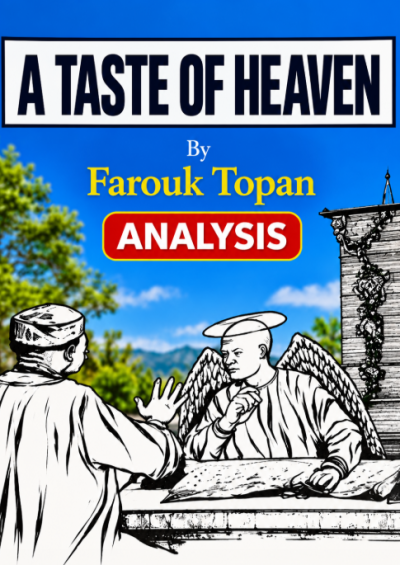
The play is set in heaven. All the direct events are taking place in heaven specifically in Ziraili’s office. The office is portrayed as having things like tables, telephones and record books. We are also given a hit about events taking place in the Love Hall where Juma enjoys free and unlimited sexual pleasure.
There are indirect settings mentioned in the play such as Bagamoyo, Britain, Dar-es- Salaam, and other planets. These are not directly involved in the actions of the play but they play important part in helping us understand the current state of affairs.
STYLE AND TECHNIQUES
The play is short but it has employed several techniques.
Dialogue
He has used the conversations among characters to reveal confusion and tension in the play. This is a common feature in any play. For example,
Ziraili: I shall tell you. (Hesitant) There is a minor mistake. (again hesitant) The mistake concerns you.
J. Hamisi: (Surprised) Concerns me? Ziraili: Yes, you.
J. Hamisi: (Anxious) How is that?
Ziraili: I was a mistake to bring you to heaven.
The dialogue helps to develop characters and themes by showing their actions and reactions.
The use of Monologue.
The play ends with a monologue from Satan who gives a long speech speaking to himself. He shows how he works behind the scenes to turn human beings into different creature like owls, chicken, donkey, peacock, dove and fish. He praises himself for
bringing Adam from heaven to earth. He boasts how he occupied a prestigious position in heaven and was told to bow before Adam and refused.
Suspense.
The playwright creates suspense by showing that a wrong soul has been taken. The rest of the story is based on this event. It creates suspense on the part of the reader and raises important questions about what will happen next. First what will those careless angels who made a mistake do to rectify the error? Second, will Juma Hamisi – who has already tasted heaven – be willing to go back to earth?
Stage Direction.
The playwright has also included stage directions to instruct the reader how the play is to be staged/performed. The above dialogue is an example for this.
LANGUAGE USE.
The language used is simple and straight forward. It has helped the reader to get the message intended by the playwright easily. However, it is also embellished with figures of speech.
Satire
The play is highly satirical. The writer uses humor to criticize serious issues like inefficiency and poor leadership. The entire play is a satire that even a perfect place like heaven there can be errors. Heaven is like a poorly run office where angels behave like careless workers. Serious issues are handled casually. The playwright criticizes real-world systems by exaggerating them in a divine setting. This mocks real-life institutions such as governments, offices, and organizations.
Irony
There is situational irony. Heaven, is expected to be a perfect place where everything is done orderly, but it is full of mistakes. Also, the Master (God) is expected to be omniscient (all-knowing) but He is presented as depending on the information brought by angels from their record books.
Symbolism
Record book →symbolizes control of human life and predestination. That what happens to human life is like a ready-made script and man has no control over it.
Telephones → symbolize prayers of the saints as a way of communicating to God. It’s not true than in heaven there are landlines like here on earth but that is just a means of communication symbolizing prayers in the heavenly realm.
Satan→ represents rebellion, disobedience, and chaos that happen on earth.
Juma Hamis→ symbolizes common people who have managed to get positions by luck but they have refused to step down. Or have forgotten those they left suffering in poverty.
The master→ represents God or a high government leader like the president who is feared by his subordinates.
Heaven→ symbolizes a socialist government that was thought to be perfect and without flaws but it proves to be wrong. Even the government thought to be perfect can be prone to mistakes.
Animals and birds→ symbolize dehumanization – the process of degrading human beings and treating them like animals by corrupt governments. Most leaders have acquired the heart of wild beasts and have lost a sense of humanity and they now treat their fellow human beings like animals.
Death → the door (the means) to heaven and enjoy the afterlife.
Barbarism.
- I am very busy Bwana! Pg 3
- You know him better Bwana pg 12
- Hodi! Hodi! Pg 22
Simile
- It’s like a father with a spoilt child pg 28
Metaphor
- The rest of these creatures are mere dolls pg28.
- They are merely tools for carrying out our will. Pg 28
Anaphora.
- Now I know. Now I understand. Pg 28
Rhetorical questions.
- Why then do I laugh at Ziraili? Don’t we belong together? Pg 29
Me, to adore Adam who is made of dust? Pg 27